This is a deconstruction, not an essay. A separate post on this site reads Transistor through culture, identity, and posthuman theory. This one takes it apart at the design level instead — mechanics, art direction, animation, level design, and sound — built from Supergiant Games' own interviews and postmortems about how the game actually got made. It's a solo piece of analysis, picking a game that felt different enough, mechanically and artistically, to be worth taking apart properly.
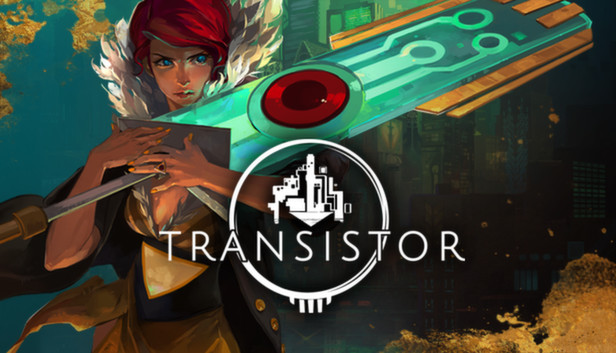
What Is Transistor?
Transistor was Supergiant Games' second game, arriving under the real pressure of following up Bastion's success. The studio's explicit goal was distance: a new IP that wouldn't read as a sequel in disguise, built around cutting-edge action mechanics, a distinct visual identity, and a cyberpunk narrative that didn't lean on convention. Nearly every major design decision below traces back to that same instinct — not "what would work," but "what would make this unmistakably not Bastion."
Integrating Planned Action with Real-Time Action
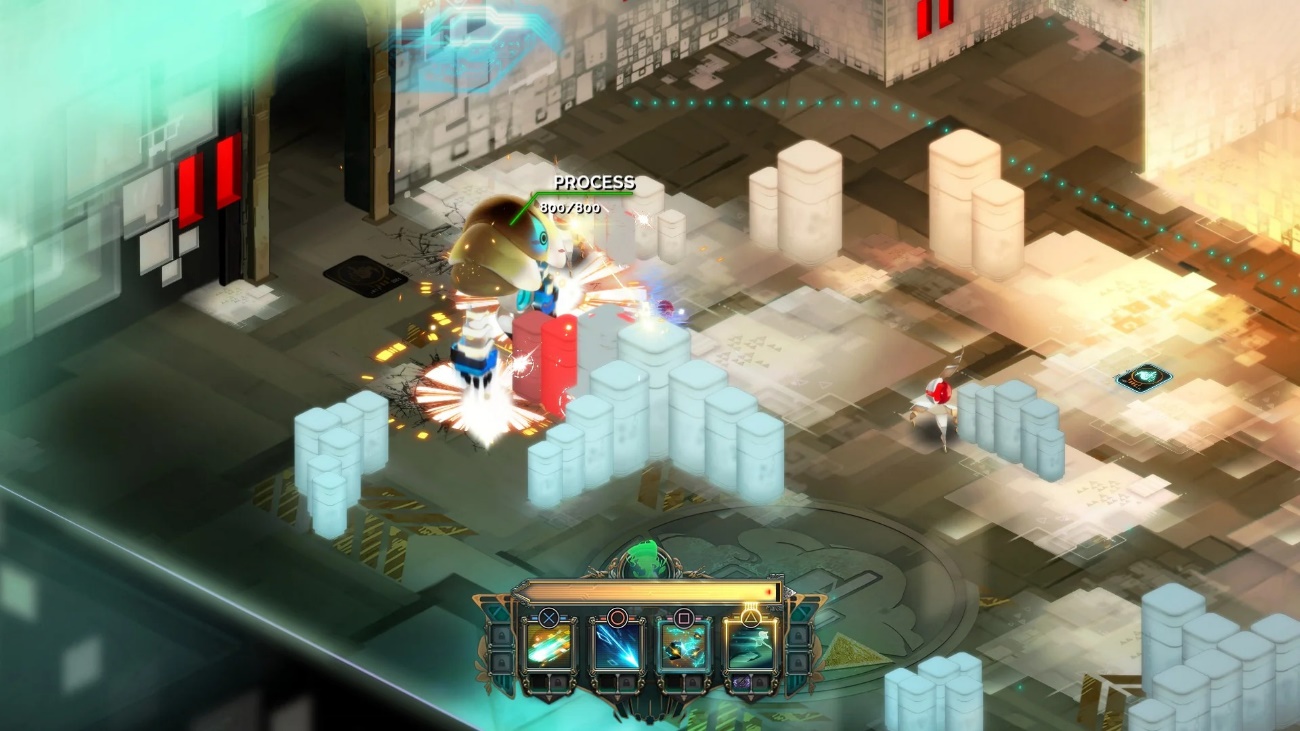
Transistor's core combat runs on a system the game calls Turn() — a planning mode layered on top of real-time action, functioning like a resource with its own cooldown, visualized as a bar. Every ability or movement used inside Turn() draws down that bar, and it has to refill before the player can use it again. Some abilities go on cooldown in real time after being used inside a Turn(); others, like the dash ability Jaunt(), have their own independent cooldown specifically so players can escape a bad situation quickly. The level design leans hard on encouraging Turn() use — using it isn't mandatory, but the game is clearly built assuming players will lean on it constantly, which keeps the player weighing both the planning phase and the real-time aftermath at once.
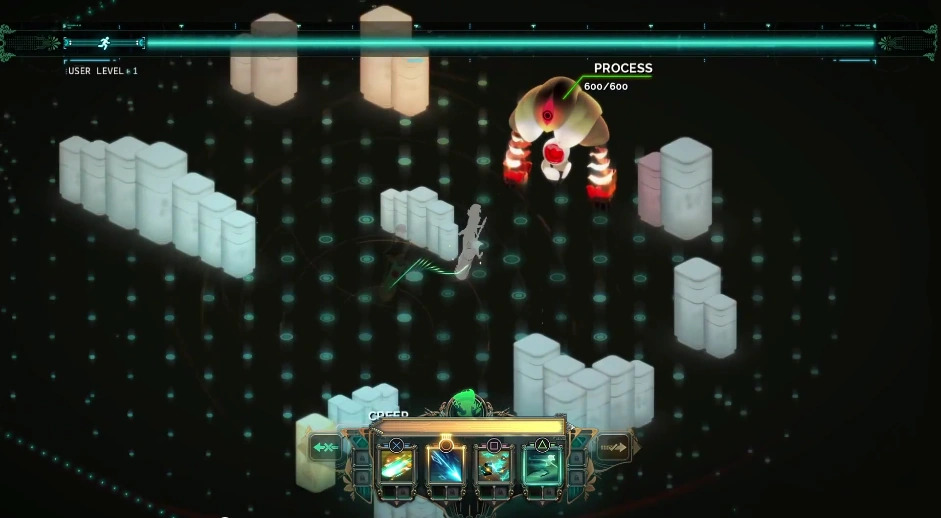
Sixteen distinct abilities — called "Functions" in-game, and each tied to the trace of a specific side character — unlock over the course of the game, combinable with each other across roughly 3,000 possible configurations, balanced by a Memory system that caps how much a player can equip at once. Every ability slot doubles as an "Upgrade Slot" and a "Passive Slot," so the same ability behaves completely differently depending on where it's attached — a basic dash becomes a camouflaged dash if paired with the right passive, for instance. Some of these combinations reportedly didn't have an obvious mechanical identity in early development; the team's approach was closer to trial and error than top-down design, actively looking for ways to "make it do something" once a combination existed on paper.
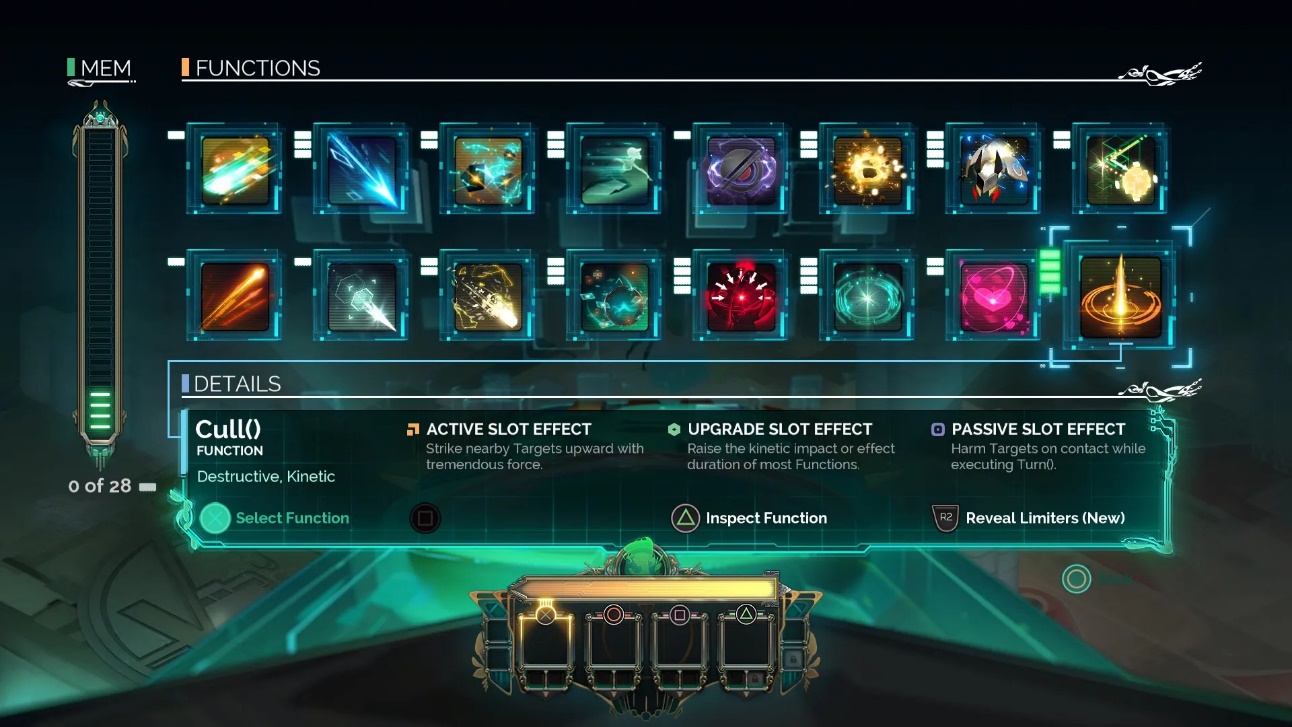
The team originally wanted ability upgrades and passives drawn somewhat randomly, card-game style — Magic: The Gathering was a stated reference point — but that randomness didn't sit well with a fundamentally linear game. The eventual fix was a "Slow Death" system: when the player's health bar empties, their highest-value equipped ability becomes unusable until a couple of save points are reached, and losing every ability sends the player back to their last save. It's a genuinely risky design, effectively giving players three chances per encounter before a hard reset, but it was judged worth it for actively pushing players toward using different abilities in different situations rather than settling on one favorite loadout for the whole game.
Enemy AI and Design Philosophy
Transistor's enemies were deliberately designed to feel aggressive and predatory — appropriate, since the player always has a time-stop option in their back pocket to counter it. According to the developers, the harder design problem wasn't making enemies competent; a shooter enemy that always aims dead-center is trivial to build. The actual challenge was making an enemy miss in a way that still reads as natural rather than random or unfair — competent enough to threaten the player, imperfect enough to avoid feeling like it's cheating, and varied enough that players can't simply memorize and "cheese" a single pattern.
Difficulty as a Dial, Not a Ladder
Transistor's difficulty system — Limiters, later reused in Hades — lets players individually dial up specific aspects of the game's challenge in exchange for a better reward multiplier, rather than picking a single static difficulty tier. That modularity gave players direct control over which parts of the game got harder, which reportedly paid off well against player feedback. The underlying design philosophy treats failure itself as something to support narratively rather than punish outright — if failure is going to be part of the experience, the studio's stated approach is to build a justified in-world reason for it, so players experience setbacks as part of the world's logic rather than as pure frustration. Limiters were also explicitly there to force experimentation: a new difficulty wrinkle — say, an enemy gaining a shield — is meant to push players toward solutions they haven't found yet, rather than letting a single strategy carry the whole game.
Narrative and Storytelling Choices
One of Transistor's earliest and most significant pivots was who the protagonist actually was. The character eventually voicing the sword — referred to during development as "the Boxer" — was originally meant to be the game's playable lead: a serious, tragic figure motivated by revenge after losing his singer girlfriend. That plan changed when the concept merged with a separate pitch — a tavern worker who falls for a traveling wizard, who is then killed and sealed inside a demonic sword — folded into Transistor's sci-fi setting. The result was Red as protagonist, with the former lead's voice and personality relocated into the sword itself.
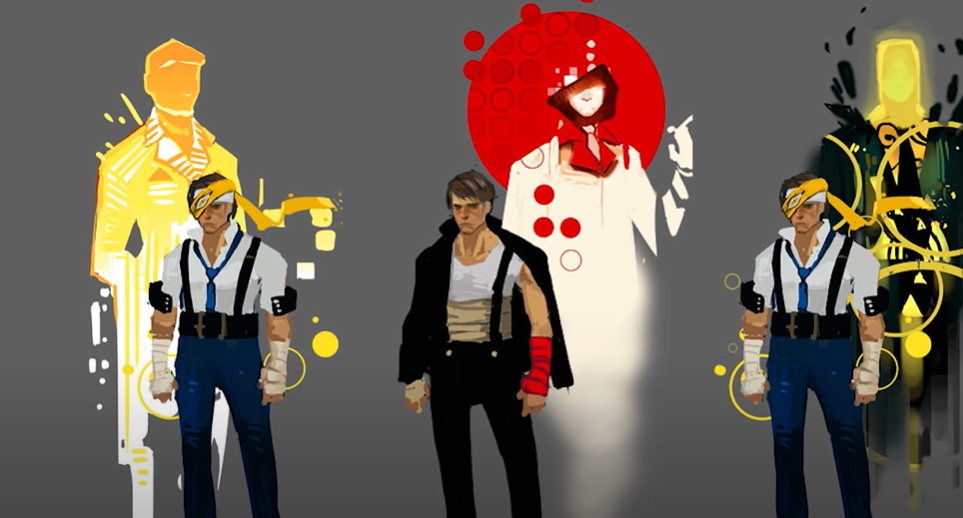
That merge created a clarity problem: players had trouble telling who was actually speaking when the sword's voice cut in, since it read more like a disembodied narrator than a character. The fix was visual rather than narrative — the sword physically lights up whenever its voice is speaking, giving players an immediate, unambiguous cue for who's talking without adding a line of dialogue to explain it.
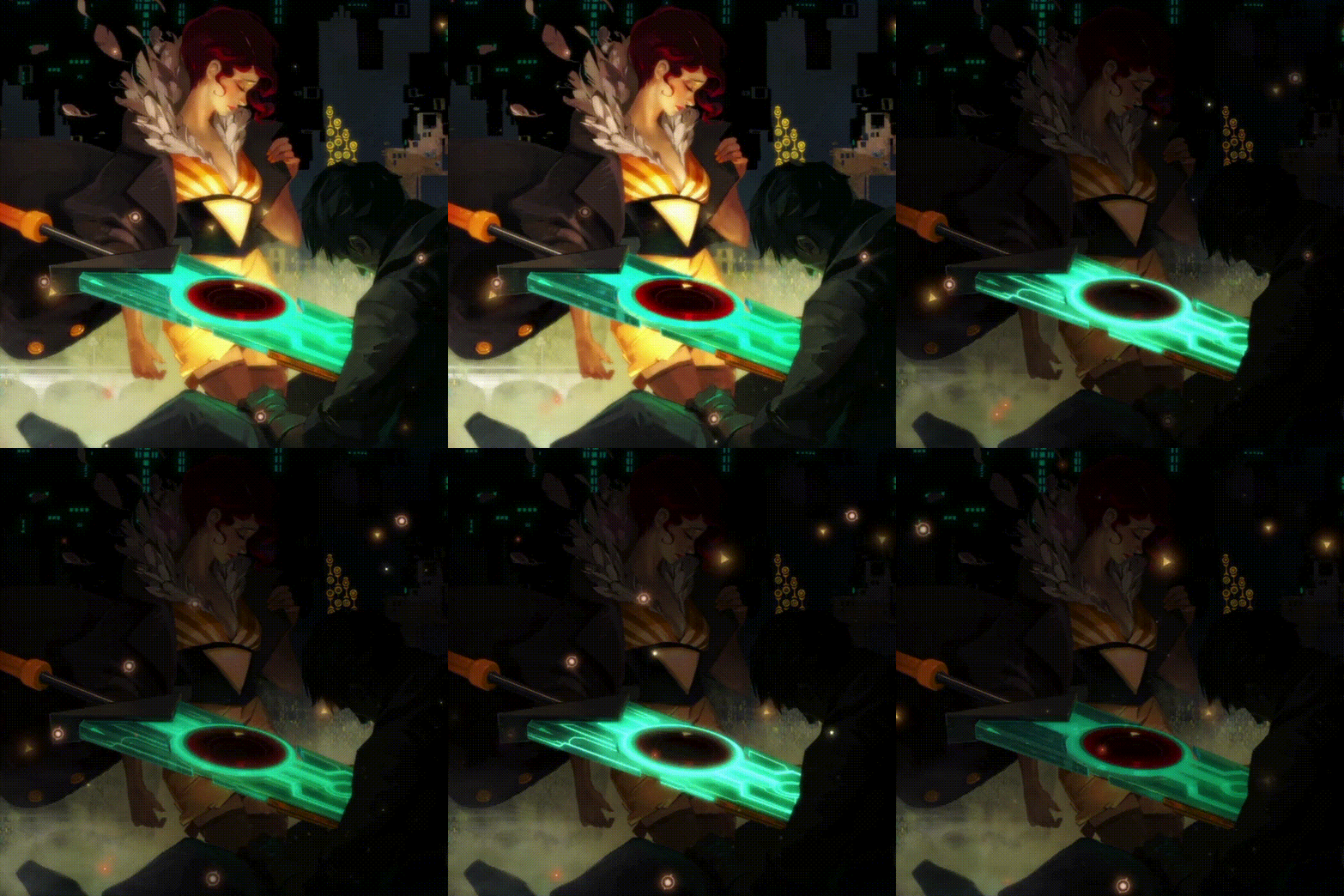
Much of the rest of the game's exposition is deliberately optional. Each of the sixteen abilities carries the backstory of the side character whose trace powers it, revealed specifically when a player experiments with that ability in different slots — a design built to reward exactly the kind of build experimentation the ability system was already pushing for, so exploring the mechanics and exploring the world become the same activity.
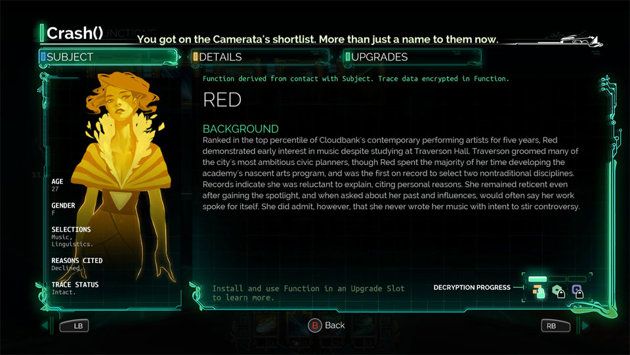
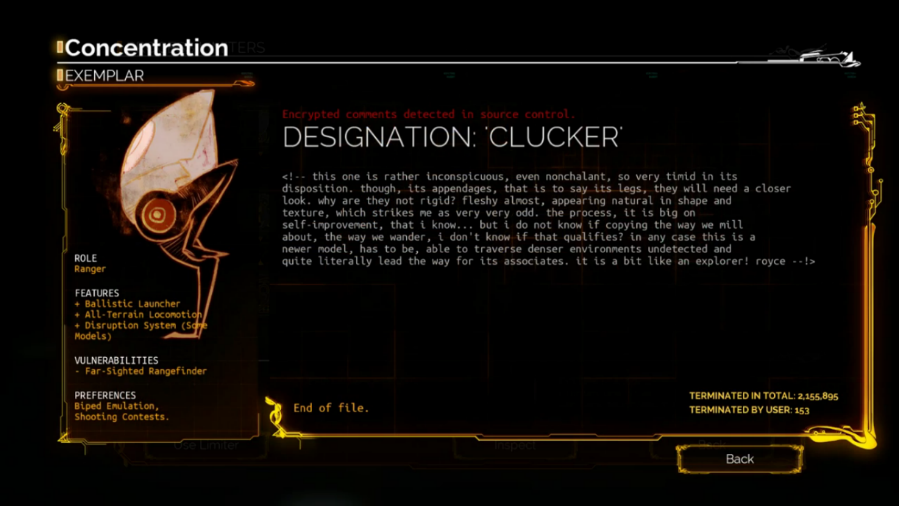
Even the presentation of that lore was considered carefully: character and enemy information panels were styled to resemble comment blocks inside source code, reinforcing the game's "world as computer system" framing at the level of its UI text. Since the game itself is fully linear and hand-built rather than open for exploration, additional lore was distributed through OVC terminals scattered across levels — optional context and backstory the game never forces on the player directly through dialogue.
Art Direction
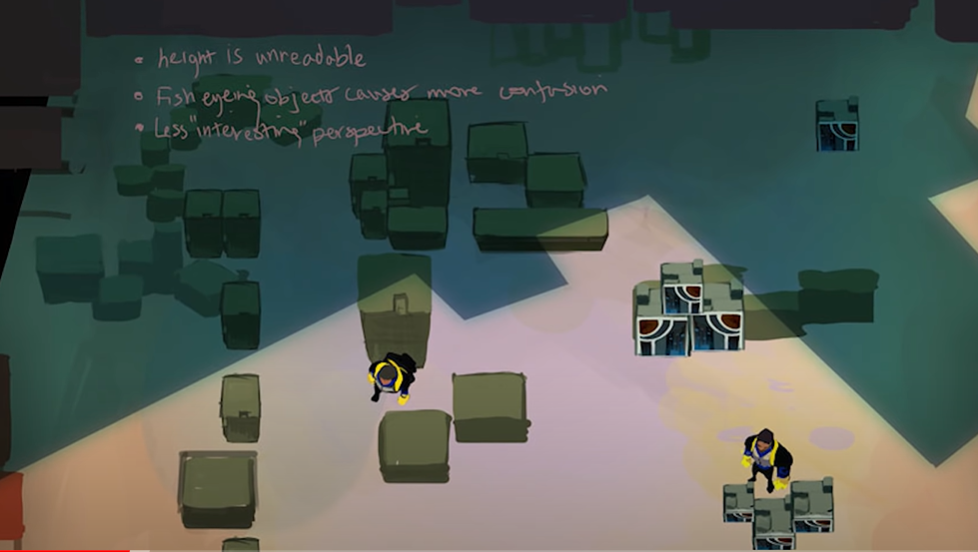
Transistor's visual identity was built explicitly against Bastion's — trading Bastion's painted, fantastical look for a stylized cyberpunk aesthetic blending science fiction with a distinctly 20th-century texture: vibrant color, surreal stylized cityscapes, detailed environments. The team wanted the game to evoke the feel of navigating inside a computer system specifically as a way of distancing it from Bastion's hand-painted landscapes, which shaped decisions at every level, down to camera work — the team tried and discarded a wide range of camera angles before landing on the isometric perspective the finished game uses.
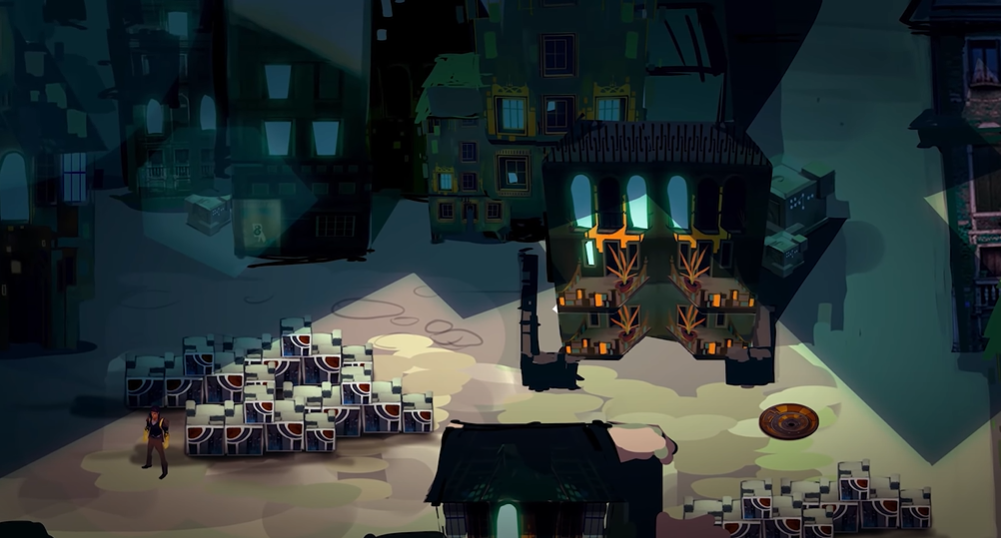
The enemies — collectively "the Process" — were deliberately given a fleshy, organic look specifically to contrast with the game's otherwise digital, sci-fi environment, marking them as invasive and out of place within Cloudbank. Their coloring was tied directly to the game's central antagonist as a narrative misdirection: aligning enemy and antagonist colors encouraged players to assume a connection between the two, which made it a genuine surprise later in the story when the enemies and the antagonist turned out to be separate, opposing forces.
Even background architecture served the isometric camera specifically: taller buildings would have eaten too much of the screen and obscured gameplay from that perspective, so shorter buildings became the primary motif, with taller structures reserved for background silhouettes only. The UI's neon color palette and particle effects were chosen for the same reason as everything else — reinforcing the cyberpunk/20th-century fusion so that world, interface, and theme all read as one coherent visual statement rather than separate design layers bolted together.

3D Art and Animation
Supergiant's art director has spoken about sci-fi settings specifically being harder to execute than other genres, since they demand active creative ideation around a future audiences already hold specific expectations about — you're designing against expectations of technology and progress that don't exist yet, rather than referencing something audiences already recognize. Player and critic reception backs up that the environment landed as intended — reviews consistently single out Cloudbank's atmosphere as one of the game's strongest qualities.



Not every review agreed on the gameplay side of that equation, for what it's worth — the environment's reception was consistently warmer than the combat's.

Building and Animating Characters in Transistor
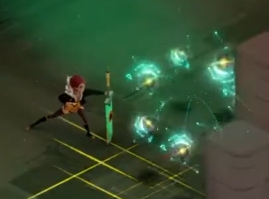
The game's sole 3D animator has described character work as built around exploring personality — how a character handles internal and external conflict — as the actual basis for animation choices, arguing plenty of animators skip that step entirely. Red's noticeably imperfect handling of the sword — dragging it and leaning into the ground rather than lifting it cleanly — comes directly from that approach: she's a singer, not a trained fighter, and her unique, imperfect movement vocabulary reflects that in a way a "generic weapon-user" animation set wouldn't.


I. Modelling
Because the game runs on a 2D engine despite using 3D character models, characters had to be rendered from multiple fixed camera angles — at least eight, to cover the isometric perspective coherently — with each angle individually adjusted for consistency rather than automatically generated. Modeling and rigging leaned on techniques closer to film and TV animation than typical game pipelines, using higher-poly models than is typical specifically because the animator working solo needed a workflow he could move through efficiently without a larger team to lean on.
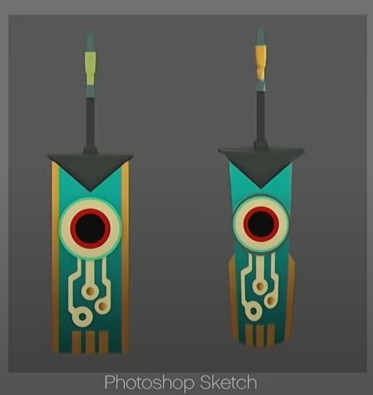
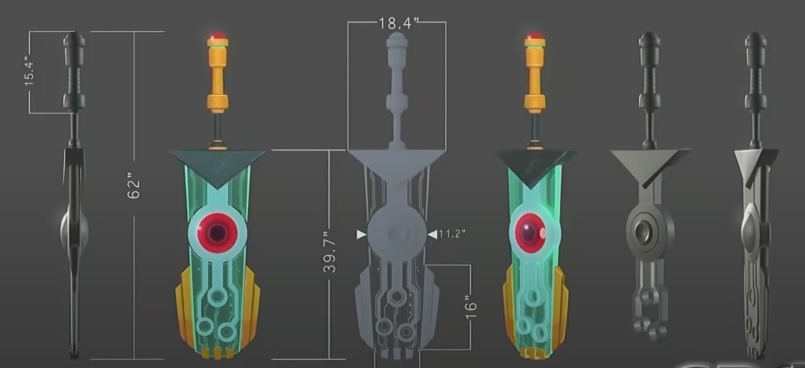
He said he stayed loyal to the art director's original sketches when modeling the sword — particularly the details meant to draw the eye, like the eye at its center and the red section on the handle — while still adjusting proportions where his own judgment suggested a better fit: the sketch's hilt, for instance, was thinner than what he ultimately modeled, widened because he felt a more visible grip would read better in the isometric view and suit the weapon's sense of unique power.
II. Rigging
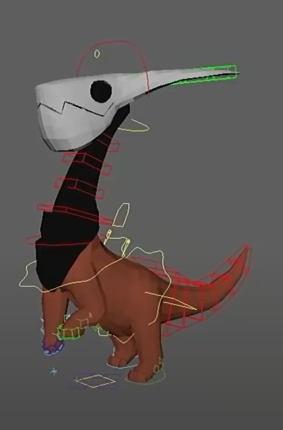
Keep It Simple. According to the animator, basic rigging principles can support building almost any type of rig. He prefers planning by hand — pen and paper — before building, then speeds up the actual process with plugins.
Shape and design in motion. He describes paying close attention to how many control options a character actually needs, how it moves, and what its characteristic silhouette is, before settling on a rig structure — mechanical-animation harmony being one of Transistor's most important qualities as an action-RPG, since no matter how unique the underlying mechanics are, the animation is what actually sells them visually.

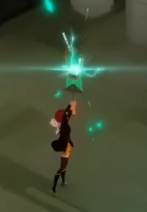
He also highlights certain animations more deliberately for mechanics that are specifically meant to stand out visually, not just functionally.

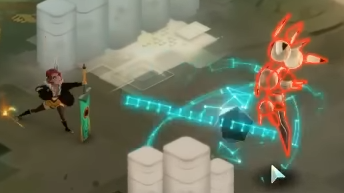
The devil is in the details. Nothing gets skipped — facial parts, hair, feathers, and fabric all get rigged using the same joint-based method as everything else, chosen specifically because working solo rewarded a repeatable process over a more elaborate one that might have produced marginally better individual results at a much higher time cost.
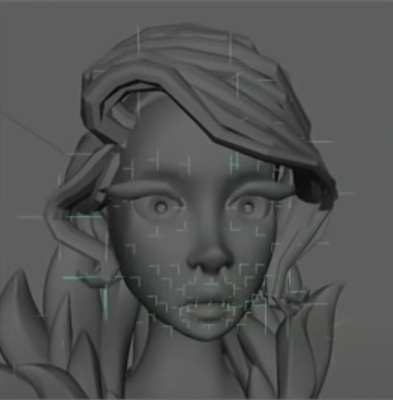
III. Animation
Lighting stayed attached to the camera throughout, keeping the protagonist visually foregrounded in every scene regardless of environment. Because the game is built on a 2D engine, animation itself is described as the biggest foundation of the gameplay — at least eight angles need to communicate the same idea coherently, so those angles were drawn over directly in the viewport to stay compatible with each other.
Animation choices were driven by a consistent set of questions asked of every sequence: what is this character feeling, where are they coming from emotionally, and how much production time is actually available for this specific beat. That process is visible directly in one of the game's more emotional beats — a wordless sequence moving through lifting, a last embrace, acceptance, setting the sword down, and finally walking away.

IV. Rendering
Rendering itself was reportedly the pipeline's biggest bottleneck — long render times pushed the team to build dedicated buffer time into the schedule specifically so testing phases downstream wouldn't get disrupted by animation still being in the oven.
Level Design
Supergiant's creative director has described the core level-design challenge as making combat feel turn-based without building an actual turn-based combat game underneath it — keeping the action-RPG foundation while layering a strategic rhythm on top. The hardest specific problem was defense: how do you let a player meaningfully plan actions in advance if there's no real mechanism to protect themselves while planning? The answer was destructible, block-like obstacles players could use for cover specifically while in Turn() mode.
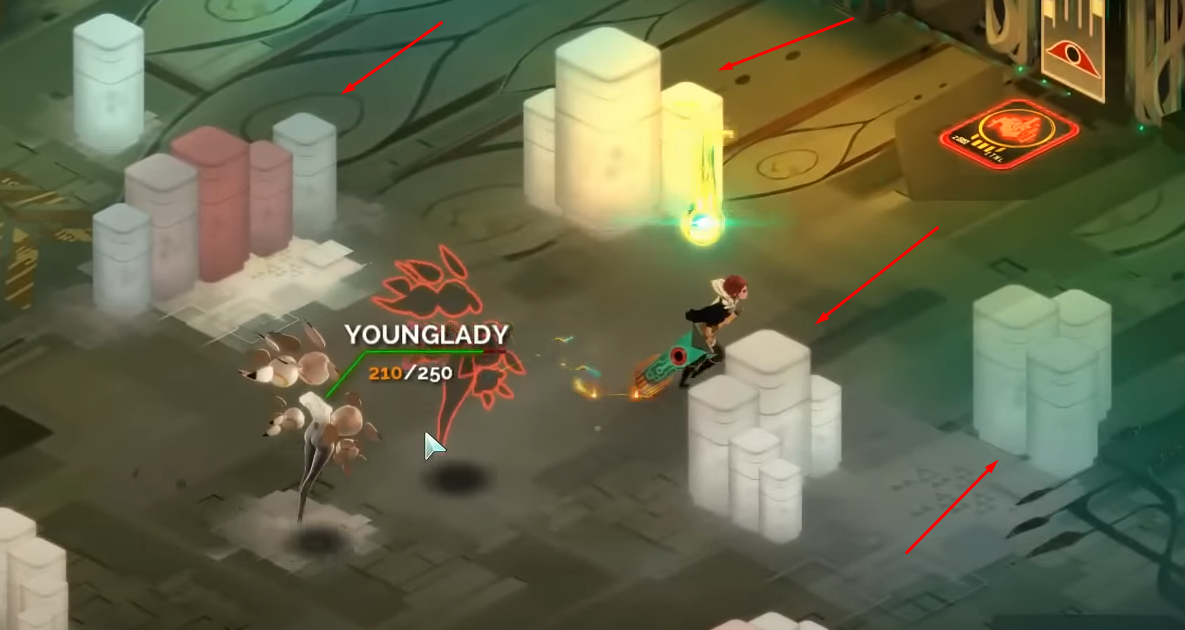
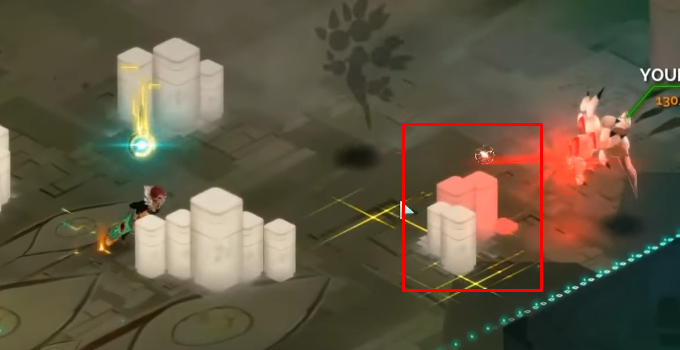
Early versions let these obstacles block damage indefinitely and stay in place permanently, which testing revealed as unbalanced — the eventual fix gave obstacles finite health and prevented them from reappearing in the exact same spot after being destroyed, keeping the tactical layer dynamic rather than letting players turtle behind a permanent wall.
Sound Design
Transistor's composer and audio director — also responsible for Bastion's soundtrack — worked with a small outsourced sound design team this time rather than entirely solo, freeing him to focus more directly on Transistor's specific needs. His stated approach was heavily iterative: build something, drop it into the game, and see what's missing by feel rather than by plan. He described starting from a place of realism — reasoning through what a given object would actually sound like — then dialing that realism back deliberately, since starting from an already-small, already-abstract sound gives less room to work with and less useful feedback to react to.
Without an existing toolkit of musical leitmotifs to draw from — his background is in rock, not film scoring — he built a specific genre palette for the game instead: electric guitars, harps, accordions, mandolins, electric piano, and synth pads, unified under a self-described "Old-World Electronic Post-Rock" label built specifically to hold that instrument mix together as one coherent sound rather than a grab-bag of textures. Vocals, performed by a session vocalist voicing Red directly, carried real narrative weight given that the player spends the entire game inhabiting a professional singer's perspective.
Midway through development, the audio team switched middleware from FMOD Designer to FMOD Studio — a genuinely significant workflow shift, since the newer tool's timeline-based structure felt much closer to a Digital Audio Workstation than its predecessor, letting a composer with a music-production background load material directly into a familiar timeline metaphor rather than fighting an unfamiliar structure. That shift reportedly deepened his understanding of routing, bus structuring, and applying effects at a much more granular level than the studio's prior tooling allowed.
Musically, Radiohead's OK Computer was a direct stated influence — the fuzzed-out synth bass on Transistor's track "Old Friends" specifically echoes the bass tone on "Exit Music (For a Film)," chasing the same glitchy, distended atmosphere. Classical influence shows up too: Tchaikovsky's Sixth Symphony's use of a 5/4 time signature to build tension gets echoed directly in Transistor's boss-fight track "In Circles," and asymmetrical meter shows up elsewhere in the soundtrack for the same tension-building purpose — a bass line running in three against a main section in five, for instance, deliberately creating rhythmic unease.
Nearly every piece of music in the game was built as multiple simultaneous stems rather than a single fixed track, letting different intensity layers turn on and off dynamically in response to what's happening on screen — a drum layer cutting in and out specifically when the player enters Turn() mode, for example. That structure meant almost the entire soundtrack (aside from the game's trailer song) was written for a specific in-game moment rather than as standalone tracks, scored dynamically rather than simply looped underneath the action.