This post merges two separate papers into one longer argument, rather than compressing either down. The first traces how comic book culture actually developed — its four "ages," and the subcultures it built along the way, from fandom itself to representation to political commentary. The second zooms all the way into one specific lens on that same history: how superhero comics use intertextuality to stage questions about posthumanism, read through Captain America and The Boys as close to opposite case studies. Read together, they make a wider point than either makes alone: comic books haven't just reflected a century of cultural change from the outside — they've run the same argument through their own central figures, one enhanced body at a time.
The Four Ages of Comics
Comic strips predate the comic book by decades — they trace back to early-20th-century newspapers, with roots even further back in France. But 1938's Action Comics #1, the debut of Superman, is usually treated as the actual birth of the modern comic book industry, opening what's called the Golden Age. Golden Age superheroes — Superman, Batman, Wonder Woman, Captain America — became cultural symbols embodying the ideals and anxieties of their moment, frequently drawn fighting the Axis powers directly during World War II, often functioning as propaganda alongside entertainment. For readers living through a genuinely global conflict, they offered hope, optimism, and a clear moral compass, closely paralleling real-world events to stay relevant. Their success was enormous enough to establish the entire industry's commercial foundation going forward.
The Silver Age, starting in the mid-1950s, marks Marvel's arrival as a major creative force. Under Stan Lee, Jack Kirby, and Steve Ditko, Marvel introduced characters defined by personal flaws and everyday problems rather than untouchable heroism — Spider-Man, the X-Men, the Fantastic Four. Spider-Man in particular dealt with school, work, and relationships alongside supervillains, making him relatable to a broader and more diverse readership than the Golden Age's idealized figures had reached. This period also saw the Comics Code Authority impose strict content guidelines that shaped what stories could even be told, pushing the industry's narrative development in specific, constrained directions for years.
The Bronze Age pushed into openly difficult territory the Code had previously kept out: drug abuse, racial discrimination, political corruption. Black Panther's 1966 debut was a genuinely groundbreaking moment, giving African American readers representation and engaging directly with themes of African heritage and identity; Luke Cage and Storm followed, breaking further racial barriers in mainstream superhero comics. This era also saw female superheroes gain more agency and depth — Ms. Marvel's introduction and a broader reappropriation of Wonder Woman for a changed cultural moment — alongside a rise in independent publishers actively challenging Marvel and DC's dominance and introducing genres the majors hadn't touched.
The Modern Age is defined by ambition and access at once. The 1980s and 90s produced critically serious graphic novels — Alan Moore and Dave Gibbons' Watchmen, Art Spiegelman's Maus — that pushed the medium to new artistic and literary ground. Watchmen deconstructed the superhero genre from the inside, building a dystopian narrative around power, morality, and identity; Maus, a Pulitzer Prize winner, used the comic form to address the Holocaust directly, demonstrating just how much weight the medium could actually carry. Alongside this artistic maturation came a technological one: the digital revolution transformed how comics were made and distributed, letting webcomics and digital platforms bypass the traditional publishing gatekeepers entirely and connecting creators directly to a genuinely global fanbase.
Comics Build Their Own Culture
Comic book culture didn't just find an audience — it built entire communities that now extend well beyond the page, and comic fandom itself has been studied as a specific kind of cultural capital, a shared currency of knowledge and enthusiasm that defines who belongs. "Geek," once a dismissive label, has been reclaimed by a community that takes real pride in its enthusiasm for comics, science fiction, fantasy, and gaming — comics provided that community's shared mythology and common ground in the first place. Media portrayal of geek identity shifted alongside it: shows and films that once would have mocked the same enthusiasm now actively celebrate it, helping pull geek culture toward the mainstream and making the label easier for people to claim openly.
Cosplay — dressing as characters from comics, anime, and adjacent media — became a subculture in its own right after originating in Japan, spreading globally through conventions and online communities where fans showcase real creativity and craftsmanship. Fan art runs on the same logic: it turns readers into active creators reinterpreting their favorite characters and stories, rather than passive consumers waiting for the next official issue. Cosplay contests specifically give that craftsmanship a stage and a community that shares tips and resources rather than competing in isolation.
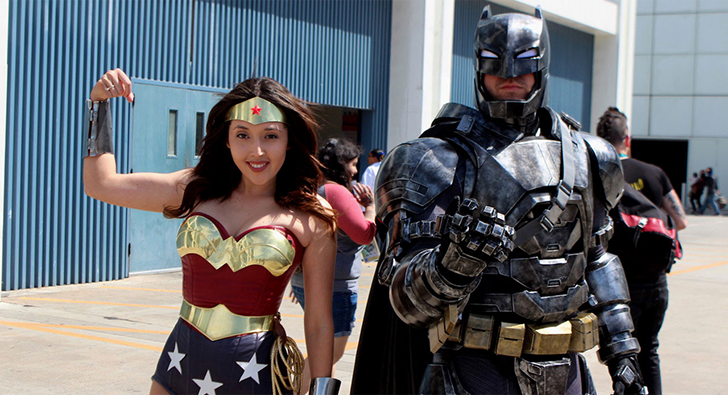
Representation is where comics' cultural weight shows up most directly. Northstar became Marvel's first openly LGBTQ+ superhero; Batwoman and Midnighter followed, challenging stereotypes and giving LGBTQ+ readers visibility inside mainstream superhero continuity rather than only in independent or underground comics — though independent and webcomic spaces expanded that representation further still, building explicitly inclusive spaces the majors hadn't reached yet. Gender representation followed a related, slower arc. Early comics regularly cast women as "the one who needs help" rather than the one doing the helping; the industry's progress since then runs through Wonder Woman — created by William Moulton Marston and read from the start as a feminist icon promoting empowerment and equality, reinterpreted across decades to track changing attitudes toward gender — through to Jessica Jones and Kamala Khan's Ms. Marvel, a book that folds identity, religion, and cultural expectation directly into its central character rather than treating them as subtext.
Comics have also functioned as a running platform for political and social commentary, going back to the openly anti-fascist messaging baked into early superhero comics and continuing through graphic novels like V for Vendetta and its critique of authoritarianism. The medium's specific ability to fuse visual and textual storytelling makes it a genuinely effective tool for engaging with complicated themes and shaping how readers think about them. Concrete examples run across decades: Green Lantern/Green Arrow tackled drug addiction and racial inequality directly in the 1970s; more recently, Ms. Marvel's Muslim-American teenage lead and Black Panther's exploration of African culture and identity have kept pushing what political commentary a flagship superhero book is willing to carry.
Finally, comics have quietly become recognized educational and therapeutic tools. Educators use graphic novels like Persepolis and Maus to teach history and social studies, leaning on the medium's visual context and emotional immediacy to make difficult subjects land. Therapists use comics similarly, as an accessible way to help clients — especially children and teenagers who might find traditional talk therapy intimidating — express themselves and process trauma or mental health struggles through a visual, narrative frame rather than a purely verbal one.
Reading Superheroes Through Posthumanism
Zoom all the way into a single superhero and a lot of this same history condenses into one body. Intertextuality is the starting concept here — the idea, in María Jesús Martínez Alfaro's phrasing, that "there are always other words in a word, other texts in a text," that a text has to be understood not as self-contained but as "differential and historical," shaped by the repetition and transformation of everything that came before it. Alfaro traces the term itself to Julia Kristeva's 1966 work, but pushes the underlying idea back much further, to Plato's insistence that a poet always copies an earlier act of creation that was already a copy of something else — good literature, on this account, has always had to resemble prior good literature to qualify as good at all.
Posthumanism gives that same framework a second, more specific axis to work along. Rosi Braidotti describes posthumanism as a critical exploration of the "multiple and mutating ways in which the human and the non-human are enmeshed in the contemporary global condition" — a framing built around relation and mutual influence rather than a fixed boundary. Stefan Herbrechter's version sharpens the challenge further, describing posthumanism as a perspective that directly "questions the boundaries traditionally separating the human from the animal, the machine, and the natural world." Superhero comics sit almost perfectly at the intersection of both ideas: built from real-world history, myth, and legend all at once, while treating the boundary of "human" as something to be enhanced, questioned, or broken outright.
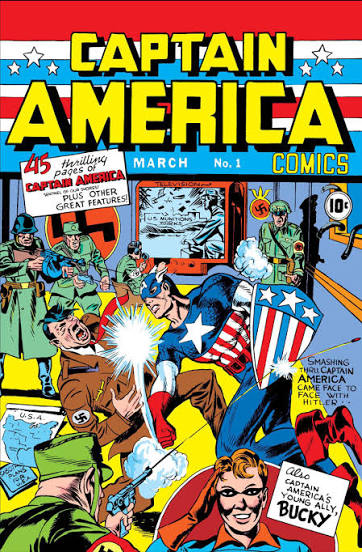
Captain America Comics #1, created by Joe Simon and Jack Kirby, was published by Timely Comics — the company that would later become Marvel — in March 1941, mere months before Pearl Harbor pulled the United States into World War II. That timing isn't incidental; it's the whole point. Steve Rogers, a physically frail volunteer, undergoes a military experiment that transforms him into an idealized soldier — a fairly direct posthumanist propaganda figure, built to support wartime recruitment through the era's own hype around bodily enhancement. Rogers' other job in that propaganda was modeling democracy itself: his enemies were consistently drawn as villainous monsters, reinforcing American nationalism issue after issue while the character delivered justice, freedom, and democracy to the world on the battlefield. The first issue's cover makes the target unmistakable — Captain America striking Adolf Hitler directly, reflecting the strong anti-Nazi sentiment already widespread in the US at the time.
The character's fortunes after the war track the culture's exhaustion with war itself. As WWII ended in horror for its victims and the Cold War kept tension alive between the US and USSR, public appetite for anything that glorified conflict collapsed, and Captain America's popularity collapsed with it, along with comparable war-coded heroes. Post-war depression pushed superheroes across the industry toward darker, more complicated portrayals — a shift in how these enhanced bodies were allowed to mean something, not just a change in plot.
The Boys, created by Garth Ennis and Darick Robertson decades later, takes the same basic posthuman premise — bodies enhanced past ordinary human limits — and inverts what it's for entirely. Its superheroes aren't corrupted by wartime propaganda; they're corrupted by fame and a capitalist corporate infrastructure that manipulates them for profit. The book's critique reframes posthumanism as a specifically technological threat: an empowering corporation exploits morally weak superheroes and becomes puppeteer for both the heroes and the society that worships them, previewing what happens when a corporate, capital-driven world gets to direct its own advantageous "advancements" toward whatever outcome the corporation wants. Chris Gavaler and Nathaniel Goldberg's work examining superhero narratives through authoritarianism and posthumanism treats The Boys as exactly this kind of subject — powerful, morally unstable bodies functioning as a threat to the society they're nominally meant to protect, rather than a guarantee of its safety.

Same underlying question, in other words — what happens to "the human" once a body is enhanced past it — answered in close to opposite registers, decades apart. Captain America stages posthumanism as heroic enhancement in service of a nation; The Boys stages it as a warning about what enhanced bodies do once corporations, not governments, are the ones pulling the strings. Posthumanism in superhero comics was never one fixed idea. It shifts with whatever the surrounding culture is actually afraid of, or hoping for, at the time — which is, not coincidentally, exactly what a century of comic book history keeps demonstrating from the outside too.
Closing Thought
Put the broad history and the close reading next to each other and the same pattern shows up twice, at two completely different scales. Comic book culture spent a century building its own subcultures, expanding who gets represented, and using its unique visual-textual form for commentary, education, and therapy alike. And inside that same century, its most iconic bodies — Captain America's enhanced soldier, The Boys' corrupted "supes" — kept restaging the exact same question the culture around them was actually asking: what happens to the human once you start adding to it. Comics never stopped asking. They've just kept changing the answer.